TL;DR:
• White label and reseller are different models, and your choice decides who the client thinks they bought from.
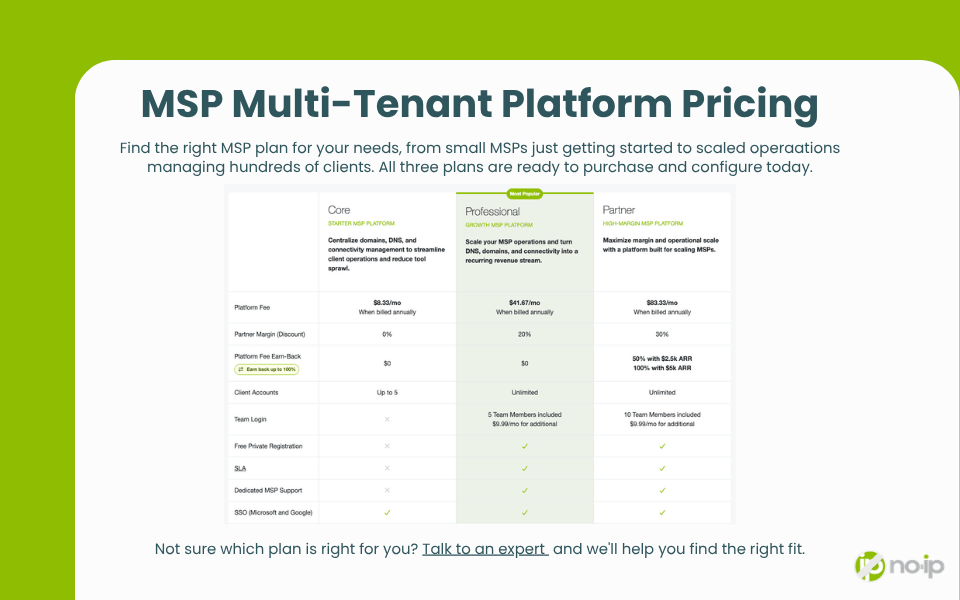
• The No-IP MSP Multi-Tenant Platform publishes partner margin tiers and lets you set your own client pricing.
• Branded remote access runs through a separate reseller program you apply to.
You are already reselling DNS. Every time you repoint a client’s NS records, chase a renewal on a domain you do not own, or fix an MX record at 11pm, you are delivering a DNS service that nobody put on an invoice.
Turning that into a line item is mostly a set of plumbing decisions. Whose account do the records live in? Whose name is on the portal the client logs into? Is your margin written down anywhere, or does it get renegotiated every year?
Here is what those decisions look like in practice, and what the No-IP MSP Multi-Tenant Platform does about them today.
Reselling DNS is a billing decision before it is a technical one
Hosting somebody else’s zone is not hard. The hard part is the second client, and the 40th.
Most DNS platforms are built for one organization managing its own domains. Add a client, and you add a login, an invoice, a renewal date, and a credential to store somewhere. Nothing about that scales, and none of it is billable. A reseller model exists to fix the commercial side of that problem, not the DNS side.
So the first question is not “can this platform host the zone.” It is “when I add my 40th client, does my cost per client go down or up?”
White label and reseller solve two different problems
These get used interchangeably, and they are not the same thing.
A reseller model means you buy at a discount and sell at your own price. The client may well know the underlying vendor. What you control is the contract, the invoice, and the margin. This is the model most MSPs actually want for DNS, because DNS is infrastructure and clients rarely care who runs it as long as it resolves.
A white label model means the client sees your brand on the thing they touch. That matters when the client logs into something themselves, which for DNS is rare and for end-user remote access is common.
Pick based on who touches the interface. If only your technicians log in, reseller pricing is what you need. If your client’s staff create their own hostnames, branding starts to matter.
What you can actually put on the invoice
Margin is only useful if there is something to sell. Through the platform, you can deliver domain registration, Managed DNS, Dynamic DNS, remote access through Public Tunnels, SSL certificates, and API access. Public Tunnels gives a client secure access to a device or network with no port forwarding required.
That list is the difference between reselling one product and building a bundle. A client paying you for Managed DNS and a couple of SSL certificates and remote access on three sites is a recurring line item, not a favor you do during onboarding.
The platform links client accounts instead of absorbing them
This is the part that decides whether reselling DNS is safe to do.
Under the No-IP model, customers keep their own accounts and grant management access to their MSP. You manage DNS, domain settings, and Dynamic DNS on their behalf while account ownership stays with them. The client keeps the chain of custody, so there is no forced transfer at the start and offboarding stays clean at the end.
That matters commercially more than it looks. A reseller arrangement where you hold the client’s assets is one the client’s lawyer will eventually ask about. One where you hold the management rights, and they hold the domain, is much easier to sign.
It also works with whatever registrar they already use. You keep DNS control without needing their registrar credentials, and they keep domain ownership. No-IP is an accredited registrar, so transferring the domain is available if the client wants consolidation, and optional if they do not.
Standardization is what keeps the margin after support costs
Reseller margin evaporates in the support queue. If every client is configured differently, every ticket is a fresh investigation.
The platform lists standardized client configurations and centralized service expiration visibility as core capabilities, which is the unglamorous half of the value. Knowing what expires next month across your book is what stops a renewal lapse from becoming a credit memo. Each team member also signs in with their own credentials rather than a shared password, with two-factor authentication and Microsoft or Google single sign-on available. Professional includes 5 team seats, and Partner includes 10, with more at $9.99 per month.
The margin is already there, it just is not written down
You have been doing DNS work for your clients for years. The question is whether the next 50 hours of it show up as revenue or as overhead.
If end-user branding is what you need, check out Branded Remote Access. The Managed DNS products cover how the DNS side works with your existing registrars.
Frequently asked questions
What is the difference between white label and reseller Managed DNS?
A reseller model means you buy DNS services at a discount and sell them at your own price, so you control the contract, the invoice, and the margin. A white label model puts your brand on the interface the client logs into. For DNS, reseller is usually enough because only your technicians touch the portal. White label matters when your client’s staff log in themselves, which is common for end-user remote access.
Can MSPs resell Managed DNS through No-IP?
Yes. The No-IP MSP Multi-Tenant Platform includes a built-in resell model. MSPs set their own client pricing and earn partner margin on No-IP services they resell, including domain registration, Managed DNS, Dynamic DNS, SSL certificates and remote access through Public Tunnels.
How much margin do MSPs earn on the No-IP MSP Platform?
Partner margin depends on the tier: 0% on Core, 20% on Professional, and 30% on Partner. On the Partner tier, revenue share also earns back the platform fee: 50% at $2,500 in annual recurring revenue with No-IP and 100% at $5,000.
How much does the No-IP MSP Multi-Tenant Platform cost?
All 3 tiers are billed annually. Core is $8.33 a month and covers up to 5 client accounts. Professional is $41.67 a month with unlimited client accounts and 5 team seats. Partner is $83.33 a month with unlimited client accounts and 10 team seats. Extra team members are $9.99 a month. Current pricing is on the MSP Platform page.
Do my clients have to transfer their domains to No-IP?
No. Clients keep their domains at their current registrar and update their nameservers to point to No-IP. That is one change at the registrar, and no domain transfer is required. No-IP is an ICANN-accredited registrar, so clients who want to consolidate can transfer later. It is optional.
Who owns the client’s domain and DNS account?
The client does. Under No-IP’s linked-account model, the client keeps ownership of their account and domains, and the MSP gets management access to run DNS, domain settings and Dynamic DNS on their behalf. When the relationship ends, offboarding is just unlinking. There is no service transfer, credential recovery or migration.
Do MSP technicians need the client’s login or 2FA codes?
No. Each technician signs in to the MSP account with their own credentials and gets one-click access into every linked client environment. There are no shared passwords and no waiting on a 2FA code from the client’s phone. MFA is required on the MSP parent account, and Microsoft or Google single sign-on satisfies that requirement.
Can I put my own brand on remote access for my clients?
Yes, through No-IP’s Reseller Remote Access program, which is separate from the MSP platform tiers. There are 2 paths: a Hosted White Label portal on your own domain, with your logo, colors and a customer-facing signup page, or an Embedded API for building DDNS provisioning into your own tools. The program is application-based, so plan time for that before promising a client a launch date.
What is the easiest DNS service for an MSP to start reselling?
Secondary DNS. No-IP runs as an additional authoritative nameserver next to the client’s existing provider, so nothing migrates and the client’s provider keeps control of every record. If that provider goes down, the zone keeps resolving. It lists at $14.95 a year per domain, at partner margin.
Does the No-IP MSP Platform work with Cloudflare or other DNS providers?
Yes. Many MSPs use Cloudflare for their own infrastructure and No-IP to manage client environments. For clients who stay on their current provider, Secondary DNS works with most providers that support zone transfers. Cloudflare only allows zone transfers on its Enterprise plan, and AWS Route 53 and Azure DNS do not support them.