For managed service providers (MSPs), DNS management has quietly become one of the biggest operational bottlenecks. Across dozens, or even hundreds, of client environments, teams juggle multiple registrars, scattered dashboards, disconnected Dynamic DNS (DDNS) tools, and separate remote access solutions.
The result? Delayed incident response, recurring service escalations, and stressed engineers stuck reacting to “DNS fires” instead of focusing on strategic initiatives. In a world where clients demand faster resolution, higher uptime, and secure connectivity, this traditional approach is no longer sustainable.
At No-IP, we’ve been listening to MSPs for over 25 years. The consistent feedback is clear: DNS management across multiple clients is complex, fragmented, and prone to risk. That’s why we built the new No-IP MSP Multi-Tenant Platform, a centralized system designed specifically for MSPs to manage domains, DNS, DDNS, and secure remote access…all from a single pane of glass.
Here, we’ll explore the evolving challenges MSPs face, the operational impact of fragmented DNS, and how centralized, multi-tenant management not only reduces risk but also unlocks new service and revenue opportunities.
The Growing DNS and Connectivity Challenges for MSPs
Today’s MSPs operate in an environment far more complex than it was a decade ago. No longer are they just managing on-premises networks: their clients’ infrastructure spans hybrid cloud environments, distributed offices, IoT devices, and remote workforces. DNS sits at the heart of all these systems.
Yet, most MSPs still manage it in ways that create friction:
- Client-controlled registrars: teams often rely on client credentials to make updates, slowing down responses and introducing security risks.
- Fragmented tools: multiple dashboards for domains, DDNS, SSL, and remote access create unnecessary complexity.
- Manual workflows: engineers spend hours manually updating records, monitoring outages, and troubleshooting connectivity issues.
- Credential sprawl: maintaining access across dozens of clients increases operational risk.
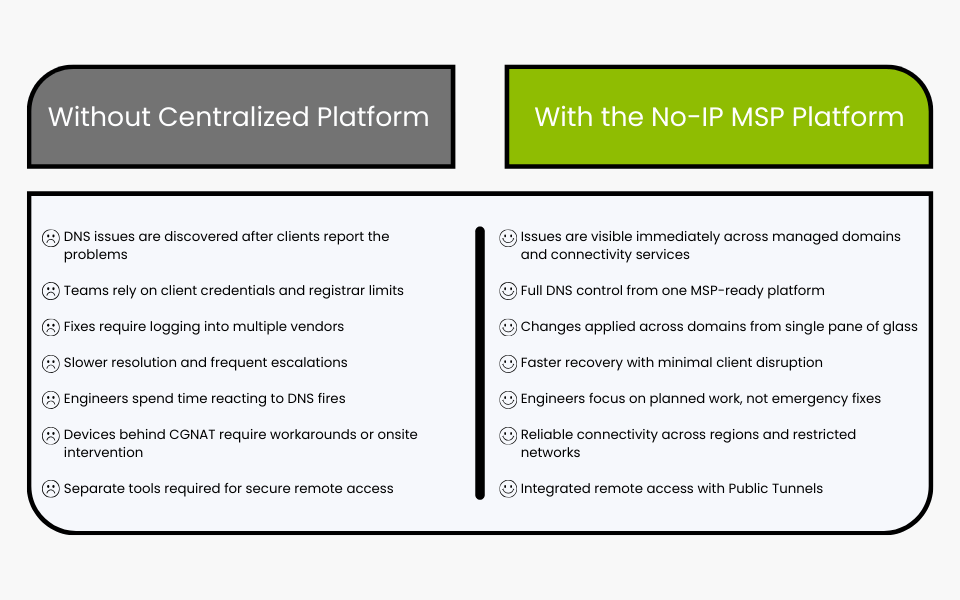
The impact is tangible: DNS issues can go undetected until clients report them, small outages escalate into business disruptions, and engineers are forced into reactive firefighting instead of strategic work.
This problem isn’t isolated. MSPs across the world increasingly report that DNS and connectivity inefficiencies limit their ability to scale operations and expand service offerings. In other words, the old way of managing DNS is no longer viable for MSPs who want to grow.
Why Multi-Tenant Centralization is the Future of MSP DNS Management
The solution lies in centralization. Just as MSPs have adopted centralized tools, DNS management is evolving toward multi-tenant, centralized control.
Centralization delivers critical benefits:
- Immediate visibility across all clients: instead of discovering issues after client complaints, teams can proactively monitor domains, DDNS endpoints, and connectivity services.
- Faster response and reduced escalations: updates and fixes can be applied across multiple clients from a single interface, eliminating delays caused by vendor or registrar access limitations.
- Standardization and consistency: centralized control enables uniform DNS configurations, reducing errors and ensuring consistent performance across all managed environments.
- Operational efficiency: engineers spend less time reacting to emergencies and more time on high-value work that drives client satisfaction and business growth.
For MSPs, multi-tenant platforms aren’t just a convenience, they’re becoming an operational necessity.
Introducing the No-IP MSP Multi-Tenant Platform
The No-IP MSP Multi-Tenant Platform was designed from the ground up for MSP systems. It consolidates domain management, DNS, DDNS, and secure remote access into a single, centralized environment.
From one dashboard, MSPs can:
- Manage domains hosted on No-IP across all client accounts
- Update DNS records and monitor DDNS endpoints in real-time
- Provide secure remote access using Public Tunnels
- Reduce reliance on client-controlled registrars
- Automate repetitive DNS and connectivity tasks through API integration
This isn’t just about efficiency. It’s about control, visibility, and scalability. Teams can now manage dozens, or even hundreds, of clients without switching between tools or worrying about disparate systems.
Operational Benefits of a Centralized Platform
Centralizing DNS and connectivity management transforms MSP operations in several ways:
1. Faster Issue Detection and Resolution
Centralized monitoring allows teams to detect DNS and connectivity issues immediately. Instead of waiting for client reports, MSPs can respond proactively, reducing downtime and minimizing client impact.
2. Reduced Outages and Escalations
By consolidating DNS, DDNS, and remote access management, the platform decreases the likelihood of misconfigurations and ensures consistent service across all clients. Fewer errors mean fewer escalations and greater client trust.
3. Improved Team Efficiency
Engineers spend less time logging into multiple registrars, chasing credentials, waiting on clients and applying repetitive updates. That time can be redirected toward strategic initiatives, service expansion, and proactive client support.
4. Enhanced Client Visibility
With multi-tenant visibility, MSPs can provide clients with better reporting, transparency, and confidence. Early detection of potential issues increases SLA compliance and strengthens client relationships. Our platform also provides insight into service and subscription expiration timelines, allowing MSPs to proactively manage renewals and receive notifications before services expire, helping ensure clients who rely on DNS, DDNS, and connectivity services maintain uninterrupted access.
5. Real-World Impact
Imagine an MSP managing 50+ clients during a DNS outage. Without centralization, engineers might have to log into multiple dashboards, coordinate with clients, and scramble to correct misconfigurations. With the No-IP platform, they can view all affected domains, apply updates in bulk, and restore services with minimal disruption.
Expanding Services and Revenue Opportunities
Beyond operational efficiency, the No-IP MSP Platform unlocks new services and revenue streams:
- Domain registration: manage client domains directly through your MSP system
- Managed DNS: provide reliable, centralized DNS services
- Dynamic DNS: support clients with devices on dynamic networks
- Secure Remote Access: Public Tunnels allow clients to connect securely without complex VPN setups
- SSL Certificates: offer encryption and security services without adding extra vendors
MSPs can bundle these services into managed offerings, creating recurring revenue while reducing tool sprawl. Channel pricing ensures MSPs have access to these services at a competitive cost, further improving margins.
Designed to Scale with Your MSP
Whether you manage 10 clients or 500, the platform scales with your operations:
- Multi-client management: centralized visibility for all domains and connectivity endpoints
- Support for shared and custom domains: flexibility for client-specific setups
- API-driven automation: automate repetitive tasks for efficiency
- Connectivity support: reliable operations across CGNAT and restricted network environments
- Foundation for future growth: add additional DNS and security services over time
This ensures operational consistency as MSPs grow, regardless of client size or network complexity.
Why This Matters Now
The MSP landscape is evolving. Clients expect:
- Fast, reliable resolution for network and DNS issues
- Minimal downtime for websites, applications, and services
- Secure remote access for distributed teams
- Streamlined, professional service delivery
DNS is at the center of all of this. Fragmentation and reactive processes no longer meet client expectations. Centralized multi-tenant management reduces operational risk, increases uptime, and provides MSPs with tools to expand their service offerings, all from one platform.
For MSPs all around the globe, adopting a centralized DNS and connectivity platform is quickly becoming a competitive differentiator.
Get Started with the No-IP MSP Platform
If you’re managing DNS across multiple clients and feeling the operational strain, it’s time to rethink the model.
The No-IP MSP Multi-Tenant Platform brings order to multi-client DNS management, reduces outages, and eliminates tool sprawl, letting your engineers focus on growth rather than firefighting.
Be one of the first MSPs to adopt our new platform and transform the way you manage DNS, DDNS, and secure remote access across client environments!
Curious? Learn More Today.
Frequently Asked Questions About the No-IP MSP Platform
What is the No-IP MSP Multi-Tenant Platform for managing domains, DNS, DDNS, and remote access?
The No-IP MSP Multi-Tenant Platform is a centralized solution designed for MSPs to manage multiple client environments. It enables teams to handle domain registration, DNS records, Dynamic DNS (DDNS), and secure remote access from a single dashboard, improving visibility and operational efficiency.
Which MSPs or IT service providers should use the No-IP Multi-Tenant DNS and connectivity platform?
This platform is ideal for MSPs and IT service providers managing multiple clients who need centralized DNS management, faster issue resolution, and scalable operations across domains, DDNS endpoints, and remote access services.
Does the No-IP MSP Platform replace domain registrars for DNS management?
No. The platform complements existing registrars by providing centralized DNS management and operational control while removing many of the limitations MSPs face when managing DNS through client-owned registrar accounts. MSPs can continue working with their current registrars while managing multiple clients from a single interface.
Additionally, No-IP is a fully accredited domain registrar. Domains can optionally be transferred into a client’s No-IP account, giving MSPs greater visibility into registration status and helping ensure domains are renewed on time so critical services never expire unexpectedly.
Can MSPs manage custom domains using the No-IP Multi-Tenant Platform?
Yes. MSPs can manage both shared No-IP domains and custom client domains. Domain registration can be transferred to No-IP if desired, but it is not required. The platform provides full DNS management regardless of domain ownership.
How reliable is No-IP’s Managed DNS for MSP environments?
No-IP’s Managed DNS infrastructure is designed for reliability and performance across distributed environments. Our globally distributed DNS network helps ensure fast query resolution and high availability for websites, applications, and services managed by MSPs. Through the MSP Multi-Tenant Platform, providers gain centralized visibility and control over DNS records, helping reduce misconfigurations and maintain uptime across multiple client environments.
What is the long-term vision for the No-IP MSP Multi-Tenant Platform in MSP operations?
The platform is designed to become a unified control layer for MSPs, centralizing DNS, DDNS, and secure remote access management. Over time, it supports operational standardization, scalability, and expanded service offerings for MSPs managing multiple client environments.