
Remote access has become a foundational requirement for modern IT teams, managed service providers (MSPs), SaaS operators, and distributed businesses. Whether it’s supporting customer environments, maintaining infrastructure, or accessing devices across locations, organizations rely on remote access every day to keep systems running.
Traditionally, much of remote access built on Dynamic DNS and port forwarding: a method that made sense when networks were simpler and network perimeter-based security was the norm. Today, however, that model is increasingly brittle. Modern networks are more restrictive, distributed, and often outside the administrator’s control, making inbound connectivity difficult or impossible.
As a result, organizations are increasingly seeking port forwarding alternatives that align with modern network realities. One emerging solution is No-IP Public Tunnels.
In this guide, we’ll explore what No-IP Public Tunnels is, how they work, how they compare to port forwarding–based remote access, and why they represent a more scalable, future-ready approach for businesses and MSPs. Public Tunnels is designed to complement No-IP Dynamic DNS, giving organizations flexible remote access options depending on network conditions.
What Is No-IP Public Tunnels?
No-IP Public Tunnels is a modern remote access method that allows customers to securely access devices, services, or applications through a simple, shareable URL without requiring inbound ports to be opened on the network. Instead of exposing a device directly to the public internet, No-IP Public Tunnels relies on an outbound, encrypted tunnel initiated from within the network. This tunnel connects to a secure access platform that brokers connections only when access is requested.
Unlike developer-focused tunneling tools designed for short-lived testing sessions, Public Tunnels is built for always-on access to real-world devices and services.
From the end user’s perspective, the experience is intentionally simple. Access happens through a browser-based URL rather than IP addresses, firewall rules, or router configurations. Behind the scenes, the complexity of NAT traversal, dynamic IPs, and firewall behavior is handled automatically. This abstraction is what makes Public Tunnels especially compelling for modern, distributed environments.
In practice, No-IP Public Tunnels works reliably in scenarios where traditional remote access breaks down. It works across ISP-managed networks, customer sites, branch offices, and environments operating behind NAT or CGNAT without additional configuration. For IT teams and MSPs, this dramatically reduces the time spent diagnosing connectivity issues and coordinating network changes with customers.
When Port Forwarding No Longer Fits Modern Remote Access
For years, port forwarding has been a reliable way to enable remote access. By mapping an external port on a router to an internal device, administrators can reach systems outside the local network. In environments with stable IPs, router control, and permissive security policies, this approach can still work well.
However, those conditions aren’t always present in modern networks. Limited router access, restrictive firewalls, CGNAT, and ISP- or cloud-managed environments can make port forwarding difficult or impractical to deploy and maintain.
As environments scale, port forwarding can also introduce operational overhead. Rules must be tracked and updated as networks change, and each exposed port increases security and maintenance responsibilities. For MSPs managing multiple customer sites, this friction adds up quickly.
No-IP Public Tunnels addresses these challenges by removing the dependency on inbound ports and router changes, enabling reliable remote access when port forwarding isn’t an option, while still allowing teams to use port forwarding where it makes sense.
No-IP Public Tunnels as a Modern Port Forwarding Alternative
Public Tunnels removes the dependency on inbound network access entirely by using outbound-only tunnels. Because the connection is initiated outbound from the device or service being accessed, it aligns naturally with modern firewall and security policies. Outbound traffic is almost universally allowed, which makes this approach far more consistent across diverse environments.
This architectural shift has meaningful practical benefits. Setup is faster because there is no need to coordinate router changes or ISP support. Access behaves consistently whether a device is deployed in a corporate office, customer site, or remote installation. Troubleshooting is simplified because connectivity no longer depends on variables outside the administrator’s control.
As a port forwarding alternative, No-IP Public Tunnels provides reliability where traditional methods fail, without requiring users to fundamentally rethink how they access systems. The result is a remote access model that feels simpler on the surface while being more resilient underneath.
Security and Zero Trust Alignment
Security considerations are central to any remote access strategy, and No-IP Public Tunnels is well aligned with modern security principles. By eliminating open inbound ports, they significantly reduce external exposure. Devices remain internal to the network, accessible only through controlled access paths rather than being directly reachable from the internet.
The use of encrypted tunnels protects data in transit and ensures that connections are established only when needed. This model aligns closely with Zero Trust concepts (p.s. coming soon!), which emphasize minimizing implicit trust and reducing unnecessary access. Rather than relying on network location as a proxy for trust, No-IP Public Tunnels focuses on controlled, intentional connections.
Public Tunnels serves as the foundation for future Zero Trust Network Access (ZTNA) capabilities, delivering immediate security benefits today while enabling more advanced access controls over time.
Remote Access for MSPs and B2B Teams
For MSPs and B2B IT teams, consistency is one of the most valuable attributes of any remote access solution. Supporting customer environments often means dealing with unknown or changing network conditions, limited administrative control, and varying security postures. Public Tunnels helps normalize this variability by providing a single access method that works across environments.
This consistency translates directly into operational efficiency. Onboarding new customers is faster because access does not depend on network reconfiguration. Support interactions are shorter because fewer issues stem from blocked ports or misconfigured routers. Teams can provide access using shared or custom domains without requiring router-level changes, which is especially useful for troubleshooting and short-term support scenarios.
By reducing friction at each stage of the access lifecycle, No-IP Public Tunnels allows MSPs to focus more on delivering value and less on resolving connectivity barriers.
No-IP Public Tunnels and the Future of Remote Access
Public Tunnels represents No-IP’s next step in modern remote access. As networks become more distributed and security models move away from fixed perimeters, access solutions must become more flexible and identity-aware.
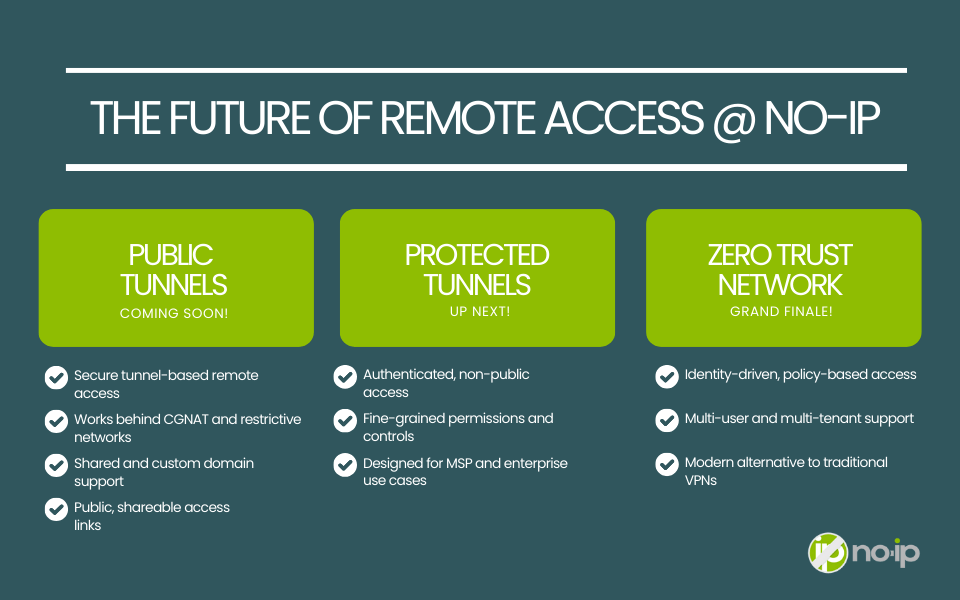
At No-IP, this evolution includes Public Tunnels today, Protected Tunnels next, and a long-term transition toward Zero Trust Network Access.
Organizations that adopt No-IP Public Tunnels today are not only solving current connectivity challenges but also positioning themselves for the future of remote access.
Is No-IP Public Tunnels the Right Remote Access Solution?
If your organization relies on remote access but struggles with port forwarding, restrictive networks, or limited administrative control, No-IP Public Tunnels is a compelling alternative. They simplify access, improve reliability, and reduce security exposure without adding operational complexity.
As modern networks continue to evolve, remote access solutions must evolve alongside them. Public Tunnels represents a clear step forward, one that aligns with how networks operate today and where access models are headed next.
~
No-IP Public Tunnels is now live! For those with Enhanced DNS and Pro DNS, Public Tunnels is an added feature that will allow you to securely access devices on any network. Click here to learn more.